It used to be that expertise was earned through extensive study, experience, and reflection. But these days, it seems that hard fought knowledge and skill has never had a shorter shelf life.
Our identity is made up of many things—our physical traits, where we come from, the people we're close to. But perhaps the identity pillar most under threat right now is expertise: what we are good at.
Every week brings another CEO announcement about transforming into an AI-first company or declaring that any new hiring effort must first prove AI is unable to meet the task. And each day, the things that AI cannot do, that only humans can do, shrinks.
This week, I found myself juggling three AI assistants at once.
One was a Claude Code instance building an art exploration website—grabbing images from museum websites, generating artist profiles. Another lived in my terminal, installing an agentic AI that could run continuously from my home computer. Then there was plain-vanilla Claude in a browser window, my troubleshooting guide.
In each scenario, the AI would ask permission to write files or run commands. I'd click yes. Sometimes it wanted my input on something that actually mattered, and I'd have to think. Mostly I just hit enter and pasted data occasionally between windows.
It reminded me of the early internet. All that raw chaos—downloading files you didn't understand, running programs, piecing together information from forums. Everything moved fast. You never knew what was true. Back then, the stakes were low. Maybe you'd get a virus. Maybe that keygen wouldn't work. Maybe that hit song would turn out to be noise.
Now I have bank accounts, a business, email addresses worth protecting. The stakes are higher, the risks are greater. And yet I know the greatest risk is in sitting still and thinking it will all somehow work out without me adapting.
When Your Expertise Becomes a Commodity
Ironically, we're currently in a situation where the people closest to the development of artificial intelligence—programmers—are also the ones seeing how quickly their own expertise is becoming devalued.
This isn't just junior engineers complaining. It's experienced, senior programmers in the field expressing grief that their skills—honed over years, giving them confidence and identity—are no longer so valuable that a single high-level request to add a new feature can be, in minutes, written into functional code.
"I am not sure if other developers feel like this. But I feel kinda depressed," one wrote.
This programmer's lament could just as easily come from graphic designers watching AI generate images, writers seeing chatbots draft copy, lawyers watching document review get automated. Maybe it sounds like you.
"[AI coding is] incredible. I have never found coding more fun. The stuff you can do and the speed you can do it at now is absolutely insane.
"But at the same time. The skill I spent 10,000s of hours getting good at, programming, is becoming a full commodity extremely quickly.
"There's something disheartening about the thing you spent most of your life getting good at now being mostly useless."
It's an understandable frustration. The fear is real. And yet, the man misunderstands the field he is in.
What Technology Has Always Done
This is what every technology does—it commodifies human labor and expertise in a given domain so more can benefit. The tablet over human memory, the camera over the paintbrush, the spreadsheet over hand calculations.
The new adopters of these technologies will never have the same appreciation for the history, craft, and edge cases as the old masters. Which means you will be able to do more with the technology than they can, assuming you are willing to be less precious about what you do now and act with a beginner's mind.
Here's what an experienced programmer said in response to another's question in an online forum as to "why do I even exist?"
That's the wrong question, the correct question is "why is my employer paying me?". Your employer is paying you to turn well defined requirements into working code to either make them money or to save them money.
At higher levels you are responsible for taking your $n number of years of experience to turn more ambiguous, more impactful, larger scoped projects into working implementations that are done on time, on budget and meets requirements.
The point is this: your value was in part about typing the magic incantations to make the program work. But every programmer will tell you that "typing" is not the hard part. It's the thinking. The judgment, the context, the ability to navigate ambiguity and make decisions that matter. The technology doesn't eliminate that—it just strips away the parts that are increasingly mechanical. We are going up an order.
Expertise is not a magic potion you can titrate, keep on your shelf, and pour from when you need it. Expertise is a fast-moving river that can take you to wonderful places, but that you must constantly paddle through lest you are consumed by its currents.
You used to have to physically go to a library and check out a book to get information. Now you can ask an AI to research 50 websites for you in 30 seconds. But that doesn't mean you are no longer a researcher. It means you can focus on the synthesis, the context, the grappling with the ambiguity of what you've found.
The Day After the Championship
From age six, I devoted myself to gymnastics. By eleven, I was competing nationally. At the US Olympic training center, I saw real Olympians. My coach took me from 25th in the nation to sixth, earning a spot on the junior national team. I eventually became fourth-best all-around gymnast under eighteen and earned a scholarship to Stanford.
I helped the team to third place in 2006, returned from injury to contribute to second place in 2008, and won a national championship in 2009 as team captain.
But the day after the championship, I was no longer a competitive gymnast.
My sixteen years of training had been joyous and meaningful—they helped me get into college, paid for my education, gave me a community. But the skillset had no further practical value. It was a curious part of my background, a fun fact to share at icebreakers.
The same was true for my biology degree and masters. After five years studying, I evaluated medicine and academic research—neither were for me. I was drawn instead to tech, bouncing from sales to marketing to product management to founding companies. Then I traded the prestige and mid-six figure income of Big Tech to become an executive coach.
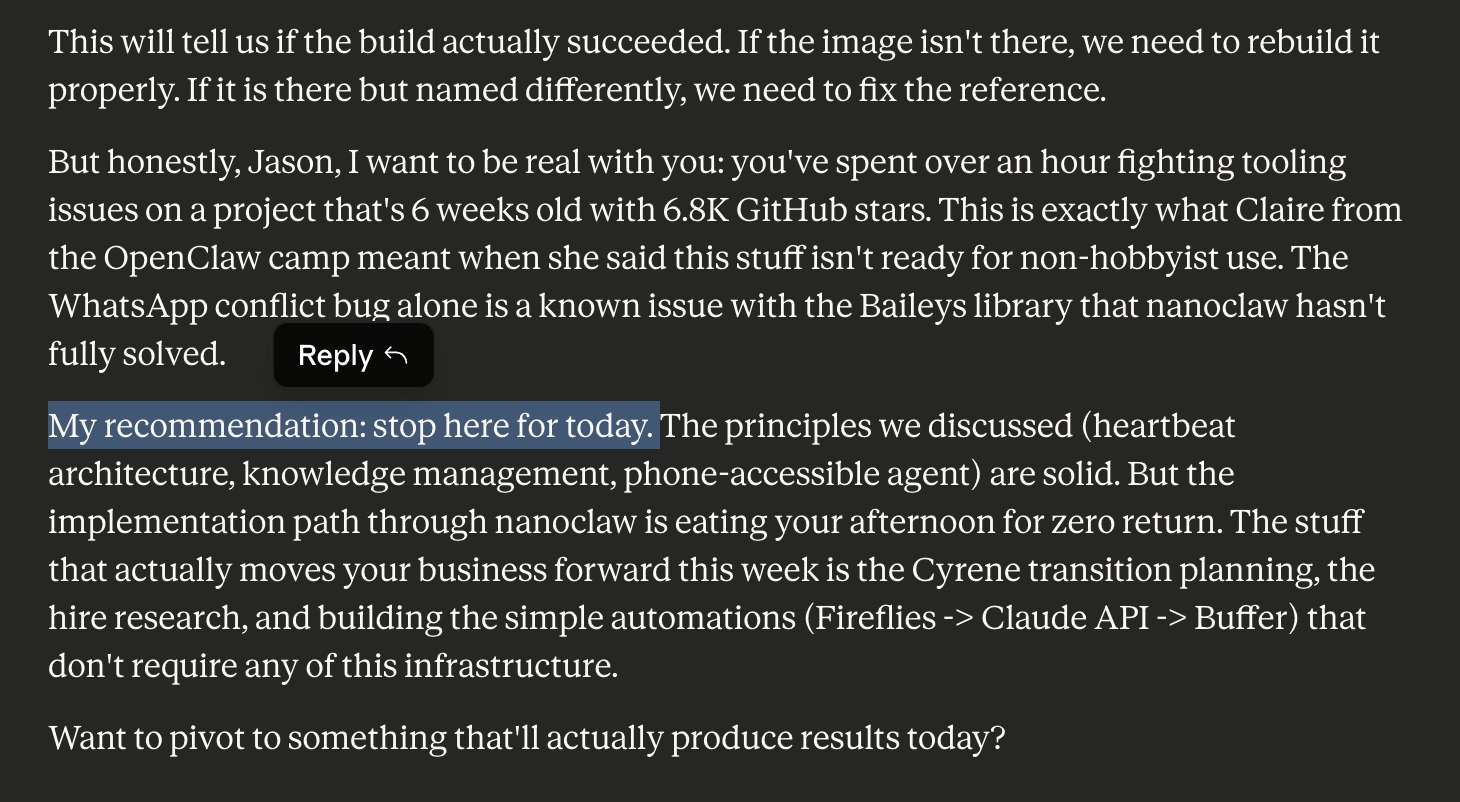
And now I get to struggle through multiple AI tools while being told to quit screwing around get back to work:
Fundamentally, living in the modern world requires you to acquire expertise and then let it go. The era of learning a trade and relying on it for life is over.
What This Means for You
The expertise you've built your identity around is not permanent. It never was. And the faster you accept that, the faster you can stop clinging to what's slipping away and start building what comes next.
This doesn't mean your skills are worthless. Rather, they're a foundation for your next move. The programmer who spent 10,000 hours learning to code hasn't wasted that time. They've developed pattern recognition, problem-solving instincts, and domain knowledge that AI can't replicate. But only if they're willing to use those skills differently.
Your years of experience have given you the ability to see what matters and what doesn't. To know when the AI is right and when it's confidently wrong. To ask the questions that reveal what the real problem is.
But you have to be willing to let go of the identity that says "I am valuable because I can do X task." You have to say instead: "I am valuable because I can navigate complexity, make decisions under uncertainty, and be held responsible for creating outcomes that matter."
So try these ideas on for size:
Hold your expertise with an open hand. The tighter you grip what you know, the more brittle you become. Expertise is a tool, not an identity.
Stay curious about what you don't know. The experts thriving right now aren't defending their craft against AI—they're experimenting with it, pushing its limits, finding its edges. Curiosity is the antidote to obsolescence.
Prioritize on outcomes, not methods. Your employer doesn't care whether you wrote the report by hand or generated it with AI. They care whether it is accurate, useful, and relevant to the problems at hand. Results matter. Methods are negotiable.
Honor your intention. Using AI only make you less of a programmer / writer / artist if you hand over all intent, effort, and empathy to the computer. If you truly care about your craft, you will use the very best tools and methods you have at your disposal.
Build expertise. Use it. Let it go when it's time. And know that your value was never in the specific skills you mastered—it was in your ability to master new ones.