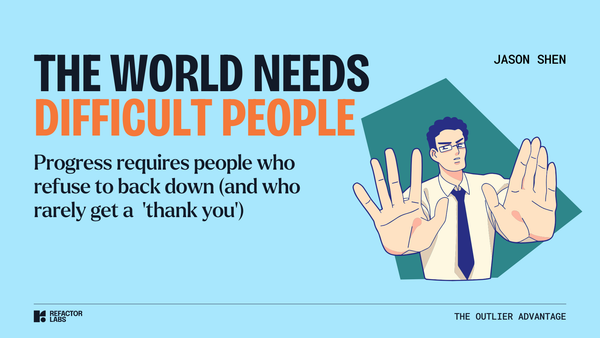
Here's something we don't talk about enough: difficult people are necessary. Not in spite of their temperament, but because of it.
People who are difficult have firm viewpoints and are hard to sway or negotiate with. They are skeptical, critiquing your ideas, challenging your reasons, pressure-testing your motives. They often come across as stern, serious, or intense. They're determined to have things work out their way, perhaps ignoring rules or defying expectations in the process.
This kind of behavior can be agitating and difficult people often pay a high price for sticking to their guns. In the police procedural The Closer, Kyra Sedgwick's character is a brilliant interrogation specialist able to extract murder confessions from resistant suspects.
She's textbook difficult: questions too-easy conclusions, ignores commands from her boss, and openly criticizes important stakeholders like the district attorney. For this she is snubbed by partners, passed over for promotions, and makes a few dangerous enemies. Despite always closing the case, she rarely receives the unqualified recognition she has earned, or the sense of belonging she craves. This is often the fate of a competent but difficult person.
Then you have easy-going people: open to differing ideas, flexible on decisions, and assume good faith. Good-natured, even-tempered, able to find humor in most situations—most of us relax a little when we know we're dealing with an easy-going person.
So are difficult people bad and easy-going people good?
It depends on what you're optimizing for. The label of difficult, like the term controlling (see #283), generally isn't seen as a good thing. But it's actually a morally neutral term. A difficult math problem, hike, or work assignment is not necessarily better or worse than an easy one. It depends on your aim.
Fundamentally, when we call someone difficult, we really just mean that it may be difficult for us to get what we want if we need their cooperation. Because they're not going to be a pushover, they're not going to go along with something they don't believe in. They won't cave or be peer-pressured into changing their mind.
Difficult people make us smarter. Intelligence agencies and cybersecurity groups use "red teams" inject contrarian ideas and combat groupthink. Research has shown that diverse teams of students are better able to solve puzzles compared to homogenous groups due to differing viewpoints and conflict—but they find the experience less enjoyable. It seems two heads are in deed better than one, but more annoying.
Political theorist Hannah Arendt saw dissent as the hallmark of a free society, that uniformity of thought led to ideology and eventually totalitarianism. She also identified what she called the banality of evil—how ordinary, compliant citizens and bureaucrats enabled the Nazi regime to commit atrocities simply by going along, by not being difficult.
We're watching this dynamic play out right now. As I write this in January 2026, ICE raids across the United States mirror the early actions of authoritarian regimes. The divide is stark: those who call for compliance, who don't want to make a fuss, and the difficult people who refuse. Difficult people shouting at immigration agents, documenting their violence, and refusing to cooperate. This is exactly what Arendt meant: dissent isn't just a nice feature of democracy, it's the immune system that fights tyranny.
Playwright George Bernard Shaw's wisdom that "all progress comes from the unreasonable (i.e. difficult) man" recognizes that changing the status quo requires sustained effort against organized resistance for a long time. Society do not change views, overturn laws, or adopt new practices overnight. It takes difficult people to push that progress forward, to insist safer standards, on a powerful powerful device, on a more humane approach. And it takes difficult people to shut things down or start over when they aren't good enough.
To no one's surprise, most founders are difficult people. As are many great artists, athletes, activists.
No one would call Steve Jobs, Serena Williams or Lady Gaga easy-going. Their stubborn, rebellious, and irascible nature were inseparable from their greatness.
And at the same time, behind every difficult person pushing for change (or resisting it) are easy-going people who smooth things over. Back when he was COO of Apple, Tim Cook, was often left to rescue relationships with vendors or employees that Jobs had left smoking in his wake. Or the alternative—No Drama Obama often relied on his fiery chief of staff Rahm Emanuel to bully, intimidate, or otherwise harass political figures into cooperation.
The world needs both easy-going folks and difficult ones. Trying to turn one into the other is a mistake. But here's what easy-going people need to understand: their agreeableness can become a liability. They can be taken advantage of, walked over, their boundaries violated. They need to be careful not to lose themselves in the pursuit of harmony.
So if you're a difficult person (likely if you've made it this far) here's what I've learned about staying true to yourself while being more effective:
Pick your battles. Every conflict takes a toll, on you and them. Not every hill is worth dying on. Prioritize the fights that are truly important to take on and let the smaller stuff go.
Accept what comes with it. You're going to be less liked than your easy-going counterparts. Decisions will take longer because of you. You'll create friction. That's the cost of insisting on better outcomes, and it's a cost worth paying if your cause is just and your thought process sound. Try not to resent people for this or take too much to heart.
Don't make it harder than it has to be. Smile. Be kind. Acknowledge good points. Forgive minor indiscretions. Admit when you're wrong. These small acts of grace don't compromise your values, they make you the kind of difficult person people respect rather than just tolerate.
In short: Be difficult when it matters. Be gracious where you can. And know that the world needs you, even if it doesn't always feel that way.